Free Download Your Desired Softwares and Apps From GetintoPC
Understanding and Fixing content cz mobilesoft appblock fileprovider cache blank html on Android
If you’ve ever gone through your Android logs, peeked into system data, or even had a strange page appear while browsing, you might have come across something like this:
content://cz.mobilesoft.appblock.fileprovider/cache/blank.html
At first glance, it looks suspicious. It doesn’t resemble a normal website or file path, and the content:// part might make it feel like something hidden or even dangerous. Some users think it’s malware, some think it’s an Android bug, and some just want to know what it’s doing on their phones.
The truth? It’s completely harmless. It’s actually part of how AppBlock, a popular productivity app, manages blocked content on Android devices.
Let’s break it all down — from the simple explanation for everyday users to a deeper technical dive for Android enthusiasts and developers. By the end, you’ll know exactly what is mean of content cz mobilesoft appblock fileprovider cache blank html, why it appears, and how to stop seeing it if it’s bothering you.
What Is AppBlock, and What Does It Do?
AppBlock is a well-known Android app made by MobileSoft s.r.o. that helps users stay focused. It lets you block apps and websites during specific times — for example, when you’re working, studying, or trying to take a digital detox.
Here’s how it works:
When AppBlock detects that you’re trying to open something you’ve blocked — say, Instagram or YouTube — it steps in and prevents it from loading. But instead of just freezing the screen or showing a generic error, AppBlock quietly redirects the request to a tiny blank web page stored inside the app.
That blank page is literally a simple HTML file named blank.html, stored in the app’s cache folder.
The location of that file, according to Android’s internal system, is represented by this URI:
content://cz.mobilesoft.appblock.fileprovider/cache/blank.html
So, when you see that URI appear in a log, browser, or app debugger, it doesn’t mean your phone is broken or hacked — it just means AppBlock replaced something you were trying to open with a safe, empty page.
What Does content:// Mean, Anyway?
In Android, apps can access data from different sources using something called URIs (Uniform Resource Identifiers).
file://→ access a file from your phone’s file systemhttp://orhttps://→ access data from the internetcontent://→ access files or data provided by another app securely
The content:// type is special. It’s part of Android’s Content Provider system, which lets apps share data safely — without exposing their real file paths.
Think of it as a locked door: only the app that owns the content can open it directly, and it can choose to give other apps limited access if needed.
So when you see:
content://cz.mobilesoft.appblock.fileprovider/cache/blank.html
you’re seeing a secure, internal address managed by Android and AppBlock. It’s not a website, not a file you can browse to manually — just a reference to a file inside AppBlock’s cache.
Breaking Down the URI
Let’s dissect it step by step:
| Part | Description |
|---|---|
| content:// | This means the data is managed by Android’s content provider system, not directly accessible by users. |
| cz.mobilesoft.appblock.fileprovider | This is AppBlock’s internal file provider authority name. It’s unique to that app. |
| /cache/blank.html | The file’s location within AppBlock’s cache — a small HTML file that loads as a blank page. |
“Open the file named blank.html from AppBlock’s secure cache area.”
Why AppBlock Uses a FileProvider
Before Android 7, many apps would use direct file paths like /sdcard/appname/files/blank.html to access or share files. That approach caused security problems — other apps could read or modify those files if permissions weren’t set correctly.
To fix that, Android introduced FileProvider, a system-level tool that hides real file paths and replaces them with safe, temporary URIs that look like content://….
So when AppBlock blocks something, it doesn’t actually move or delete files — it just tells the browser or system to load blank.html instead, through a FileProvider.
This keeps your data safe, avoids crashes, and ensures AppBlock’s functions remain isolated from the rest of your system.
When and Why You Might See This URI
There are a few situations where this URI might appear:
- When AppBlock blocks a website or app
You tried to open something on Chrome, but AppBlock replaced it with its blank page. - In debugging tools or system logs
If you’re a developer, or you use tools like Logcat or Bug Report, you might see this URI when the app logs a redirection. - After uninstalling AppBlock
Sometimes leftover cache references remain, so your browser or another app might still show this path briefly. - When a background app is blocked
Some Android services or ads get blocked silently by AppBlock, and the blank.html placeholder gets used behind the scenes.
In all these cases — it’s completely safe.
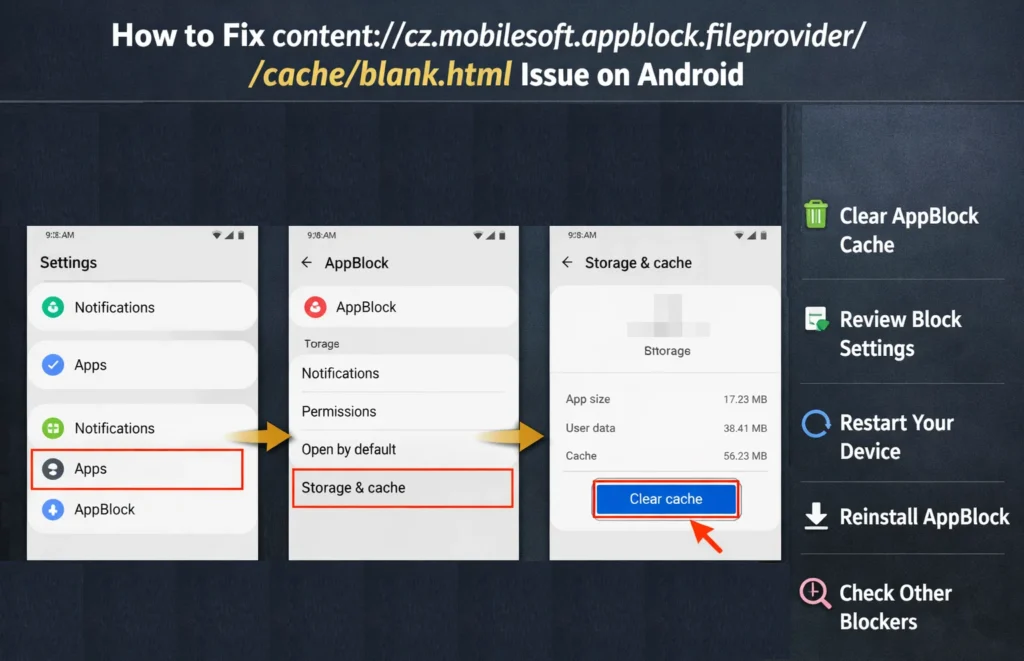
How to Fix or Stop It (If It Keeps Appearing)
If the blank.html screen keeps showing up when you browse, or if your logs are full of these messages, you can reset AppBlock easily.
1. Clear AppBlock Cache
Go to: Settings → Apps → AppBlock → Storage & Cache → Clear Cache
2. Review Your Block Settings
Open the AppBlock app → tap on your blocking profile. Make sure you haven’t accidentally blocked your main browser or system apps.
3. Restart Your Device
Sometimes Android caches the content URI itself. Restarting clears that out.
4. Reinstall AppBlock
If the URI still appears after uninstalling, reinstall AppBlock, then uninstall it again. This cleans up all leftover references.
5. Check for Other Blocking Apps
If you’re using other focus or ad-blocking apps, they might conflict. Stick with one blocking app at a time.
For Developers: How AppBlock Uses FileProvider Internally
For developers curious about how this works under the hood — here’s the likely setup (simplified).
AndroidManifest.xml
<provider android:name="androidx.core.content.FileProvider"
          android:authorities="cz.mobilesoft.appblock.fileprovider"
          android:exported="false"
          android:grantUriPermissions="true">
    <meta-data android:name="android.support.FILE_PROVIDER_PATHS"
               android:resource="@xml/file_paths" />
</provider>
file_paths.xml
<paths xmlns:android="http://schemas.android.com/apk/res/android">
    <cache-path name="cached_files" path="." />
</paths>
That XML defines which directories the FileProvider can safely expose. When AppBlock generates the blank.html file, it stores it in its cache folder, and the FileProvider generates a temporary URI pointing to it.
This way, no other app can access the file unless explicitly granted permission.
Final Verdict
If you’re seeing
content://cz.mobilesoft.appblock.fileprovider/cache/blank.html
…there’s no reason to panic.
- It’s not a virus.
- It’s not spyware.
- It’s not a sign of system failure.
It’s just AppBlock doing its job — helping you stay focused by blocking access and quietly replacing content with a blank page.
Unless it’s causing an actual usability issue, there’s nothing you need to do. But if it gets annoying, now you know how to clean it up in just a few taps.
FAQs
What is content://cz.mobilesoft.appblock.fileprovider/cache/blank.html on Android?
The content://cz.mobilesoft.appblock.fileprovider/cache/blank.html file is usually related to the AppBlock application on Android. It may appear when the app temporarily stores cached web content or blocks access to certain websites or apps.
Why am I seeing a blank HTML page in AppBlock?
A blank HTML page may appear if AppBlock is blocking a webpage, browser request, or app content. In some cases, corrupted cache files or permission conflicts can also cause the issue.
How do I fix the cz.mobilesoft.appblock.fileprovider cache blank html error?
You can try fixing this issue by clearing the AppBlock cache, restarting your device, updating the app, or removing and reinstalling AppBlock. Checking browser permissions and Android storage access may also help resolve the problem.
Is content://cz.mobilesoft.appblock.fileprovider/cache/blank.html harmful?
No, this file path is generally not harmful. It is usually a temporary cached file created by the AppBlock app on Android. However, if it appears repeatedly or causes browser issues, clearing app data may help.
How do I clear AppBlock cache on Android?
To clear AppBlock cache, open Settings > Apps > AppBlock > Storage & Cache, then tap Clear Cache. This can remove temporary files that may be causing blank page issues.
Can AppBlock interfere with browser pages?
Yes, AppBlock can sometimes interfere with browser pages if website restrictions or blocking rules are enabled. Disabling certain blocking settings temporarily may help identify the cause.